SAP ERP Mainstream Maintenance ends in 2027. How companies can implement their S/4HANA migration in a structured, low-risk, and predictable manner with the Manage Now Transcelerator.


SAP ERP Mainstream Maintenance ends in 2027. How companies can implement their S/4HANA migration in a structured, low-risk, and predictable manner with the Manage Now Transcelerator.
2027 still sounds like a date with a buffer. But anyone who looks at the project durations of real S/4HANA migrations knows: the buffer has long since evaporated. With the end of SAP ERP Mainstream Maintenance, one of the biggest IT transformation projects of the coming years is inevitably approaching for many mid-sized companies and corporations. The paid Extended Support extends until 2030, but those who wait until then pay a premium, both financially and in terms of risk.
However, the actual problem rarely lies solely in time pressure. It lies in the complexity that has grown over years: convoluted system landscapes, deeply rooted custom developments, dependencies that hardly anyone fully comprehends anymore. It is precisely this complex interplay that turns a supposedly technical conversion into a project that affects processes, organization, and governance equally. And because more and more companies are migrating simultaneously, the market for experienced migration partners is noticeably tightening.
As Mainstream Maintenance expires, not only do the operating and maintenance costs of existing ERP systems increase. Security and compliance risks also rise, while access to new SAP innovations becomes increasingly restricted. Investing today in a system that SAP is only minimally developing further means investing in stagnation.
At the same time, migration involves much more than just fulfilling an obligation. If approached correctly, it is an opportunity to streamline overgrown process landscapes, establish end-to-end processes, and sustainably reduce operating expenses. S/4HANA, in combination with the SAP Business Technology Platform, also creates the technical basis for everything that comes next, from AI-driven processes to automation through RPA.
Experience from numerous S/4HANA projects reveals a recurring pattern: failures or delays almost never arise from the technology itself, but from a lack of preparation. Insufficiently analyzed custom code, underestimated efforts for third-party system integrations, missing resources in IT and business departments, unclear target definitions. All of this can be avoided if transparency regarding the system, contract, and infrastructure situation exists from the outset, and the entire SAP ecosystem, including connected third-party systems, is evaluated.
This is precisely where the Manage Now Transcelerator comes in. Instead of considering technology, business departments, and project management separately, the methodology connects three workstreams from the start to form a well-founded preliminary study: the technical workstream with system analysis, platform evaluation, simplification check, and custom code analysis; the functional workstream with evaluation and prioritization of business processes; and project management, which defines time and cost frameworks and plans change and quality assurance measures.
Based on this, implementation follows, either classically or agile, depending on company size, complexity, and strategic goals. Four phases structure the path: preliminary study and readiness check, conception and design with selection of the appropriate transformation approach between Greenfield, Brownfield, and Selective Data Transition, the actual implementation including automated custom code migration, and finally testing, training, and go-live with cutover planning and hypercare phase.
Hardly any factor causes delays in S/4HANA projects as reliably as underestimated custom code. This is precisely why Manage Now developed the S/4 Custom Code Engine, or SCCE for short. It automatically converts custom developments to HANA and S/4HANA-compatible code, at a fixed price and with full transparency regarding scope and effort. The result: noticeably shorter project durations and predictability in terms of time and costs that classic migration approaches rarely offer in this form.
The migration to S/4HANA can no longer be postponed, but it doesn’t have to be a risk. With a structured methodology, integrated consideration of technology, processes, and project management, as well as automated custom code conversion, a dreaded major IT project becomes a predictable, controllable step towards a future-proof, digital, and scalable enterprise IT.
Would you like to know where your company stands in terms of S/4HANA readiness? Speak with Manage Now; we will advise you individually on your situation.
System complexity, custom code scope, and the chosen transformation approach. The Transcelerator’s preliminary study provides a binding timeframe, and SCCE automation significantly shortens the duration compared to classic approaches.
Costs arise from licenses, infrastructure, project work, and custom code conversion. The SCCE makes at least the latter predictable, with a fixed price. After the preliminary study, a transparent overall cost framework is available.
That depends on process quality, data situation, and strategic goals. The Transcelerator analyzes all three options as part of the preliminary study and provides a well-founded, unbiased recommendation.
It is automatically analyzed and made S/4HANA-compatible via the S/4 Custom Code Engine, at a fixed price and with full transparency regarding scope and effort.
The readiness check within the preliminary study shows exactly where a company stands. Manage Now supports targeted preparation and only starts the actual migration once all prerequisites are met.
Subscribe to our newsletter to receive regular updates, invitations to our events, and exclusive IT insights.
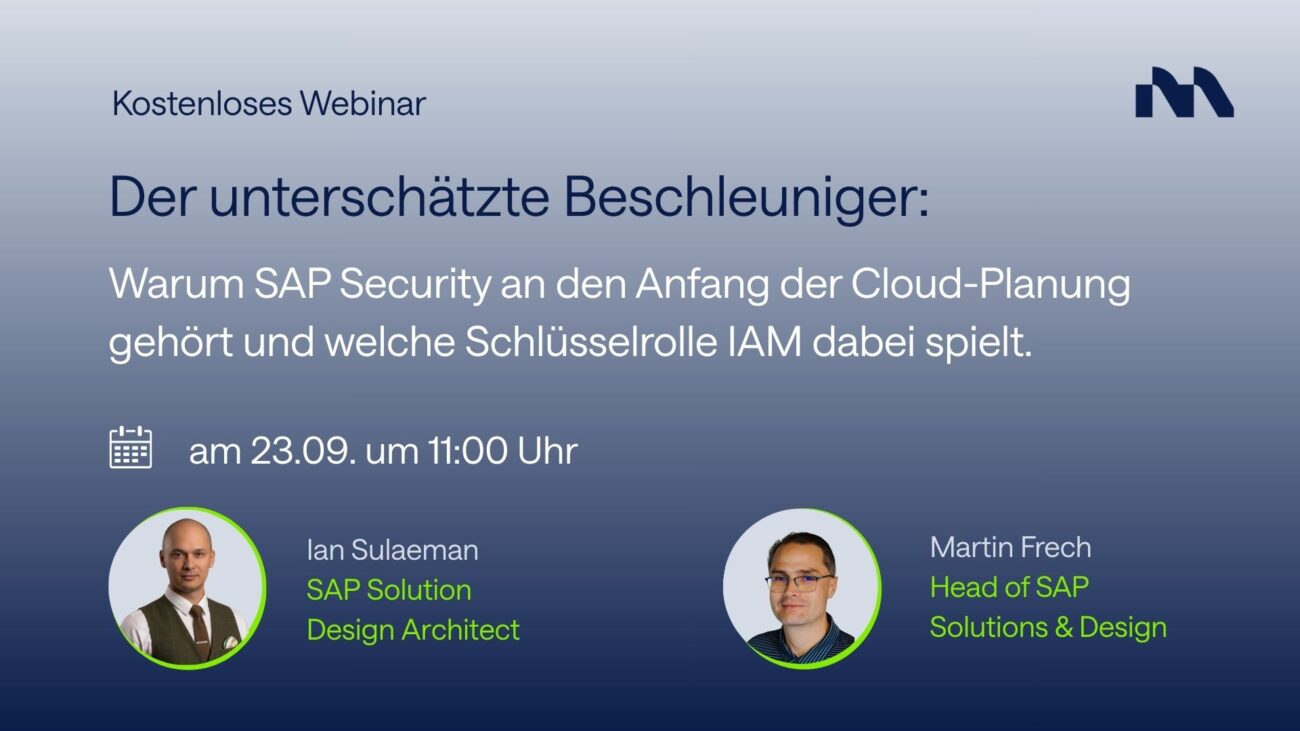
Ohne solides Fundament gelingt keine Cloud-Transformation. Wer SAP Security erst nachträglich angeht, riskiert Audit-Findings, Verzögerungen und hohe Kosten.
Definieren Sie deshalb von Anfang an einen klaren SAP Security North Star. In diesem Webinar zeigen wir, wie eine durchdachte IAM-Architektur (IAS/IPS, Identity Governance, Zero Trust) als strategischer Beschleuniger wirkt und hybride Landschaften von Tag 1 an skalierbar macht.